Cartagena

Over 2,500 years of history of a harbour

Mastia · Qart Hadasht · Carthago Nova · Qartayannat al-Halfa · Cartagena

Scroll
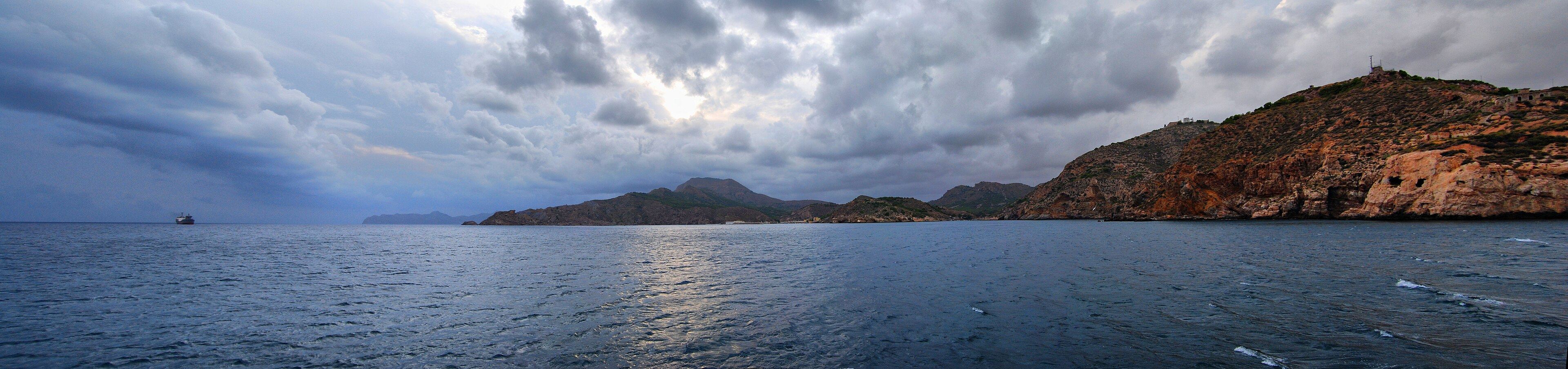
Panorama of the entrance to Cartagena harbour
Harbour entrance · Manuel Martín, CC BY 2.0
  1. Mastia and the Iberian world

    6th–3rd centuries BC

    Its name: Mastia (or Mastia Tarseion)

  2. Iberian

    Mastia, a harbour at the head of a bay

    Peoples of the Iberian Peninsula around 200 BC · The Ogre and Alcides Pinto, CC BY-SA 4.0

    On the south-east coast, sheltered by a natural harbour almost enclosed by hills, there stood an Iberian–Tartessian settlement that Greek and Roman sources call Mastia (or Mastia Tarseion). The metals of the nearby sierra and trade with Phoenicians and Greeks made it a useful outpost.

  3. Iberian

    Mastia in the treaties of Rome and Carthage

    The historian Polybius cites “Mastia of the Tarseians” in the treaties between Rome and Carthage as a limit the Romans were not to cross for sailing or trade.

  4. Qart Hadasht, Barcid capital

    227–209 BC

    Its name: Qart Hadasht «New City»

  5. Barcid Name changes → Qart Hadasht

    Hasdrubal founds Qart Hadasht

    Punic wall of Cartagena · María Rodriguez, CC BY-SA 4.0

    The Carthaginian general Hasdrubal the Fair founds “New City” — that is what Qart Hadasht means — as the capital of Carthaginian rule in Iberia, on the site of the older settlement. He chooses a sheltered harbour, close to the sierra’s silver, and has a palace built for himself.

  6. Barcid

    Hannibal sets out from here

    Hannibal’s route from Cartagena to Italy · Kordas, CC BY-SA 3.0

    After Hasdrubal’s assassination, command passes to Hannibal Barca, who from Qart Hadasht prepares the campaign that would take him to Saguntum and, in 218 BC, across the Alps with elephants: the Second Punic War. His army mixed Carthaginian and Libyan contingents with allies and mercenaries: Numidian horsemen, Balearic slingers and Iberian infantry recruited on the peninsula. According to the sources, he left from here with some 90,000 infantry, 12,000 cavalry and 37 elephants (figures debated).

  7. Barcid Name changes → Carthago Nova

    Scipio takes the city in a day

    The siege of Cartagena (209 BC) · MagentaGreen and Cristiano64, CC BY-SA 4.0

    Publius Cornelius Scipio, with some 27,000 men according to the sources, attacks by land and sea. According to Polybius and Livy, he used the low water of the lagoon that protected one side of the city to enter with his soldiers. He seizes the booty, stores, weapons and Iberian hostages, and the city passes to Rome. Mago Barca, who commanded the Carthaginian garrison (about 1,000 men, according to Polybius), held out in the citadel and finally surrendered; Scipio sent him as a prisoner to Rome. According to Livy, the centurion Quintus Trebellius and the marine Sextus Digitius disputed who had been first onto the wall, and Scipio awarded both the mural crown. Among the hostages of the Iberian tribes were relatives of chiefs such as Indibilis and Mandonius, of the Ilergetes, and Edeco, of the Edetani; Scipio returned them without ransom and thereby won many allies.

  8. Roman Carthago Nova

    209 BC – 5th century AD

    Its name: Carthago Nova «New Carthage»

  9. Roman

    Silver, lead and garum

    Mining installation in the Cartagena-La Unión mining range · orse, CC BY-SA 2.0

    Under the name Carthago Nova the city becomes the great Roman harbour of the south-east: silver and lead mines, salted fish and garum, and esparto from the so-called Campus Spartarius.

  10. Roman

    Colonia Urbs Iulia Nova Carthago

    Bronze as of Carthago Nova (Augustan period) · Bibliothèque nationale de France, public domain

    It is raised to a Roman colony — tradition links this to Julius Caesar — with a forum, colonnaded streets and public buildings.

  11. Roman

    The Roman theatre

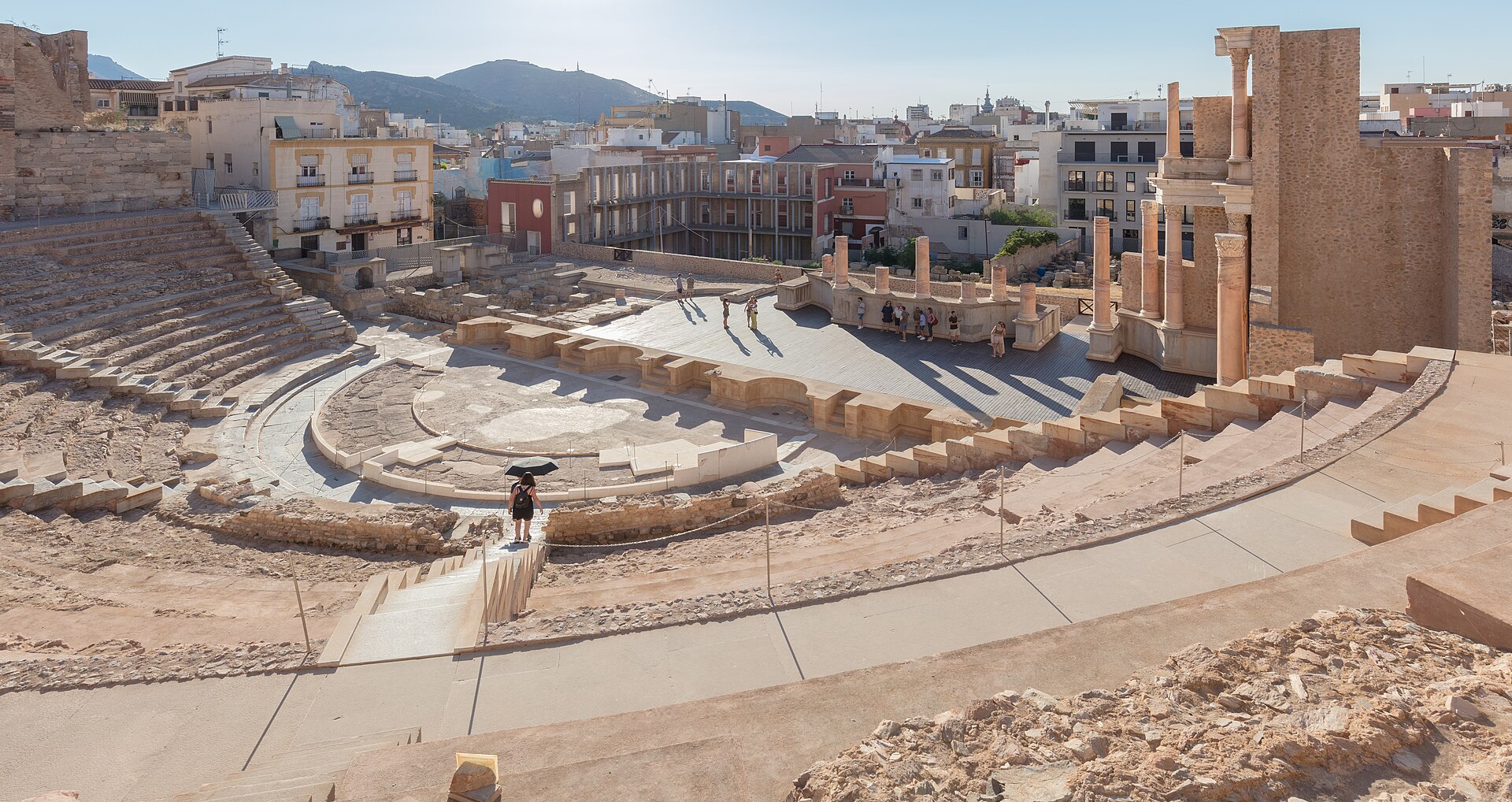
    Roman Theatre of Cartagena · Diego Delso, CC BY-SA 4.0

    It is built on the slope of Concepción hill, seating about 6,000 spectators and linked to Augustus’s family. Over time it was buried under houses and a bullring.

  12. Roman

    The city of the forum and baths

    Roman forum of Cartagena · María José Rodriguez Marrero, CC BY-SA 4.0

    Districts with rich houses with mosaics and paintings, baths, and a forum with colonnades.

  13. Roman

    The Vandals and the end of Rome

    The city suffers a Vandal sack amid the collapse of the Western Roman Empire.

  14. Byzantium and the Visigoths

    6th–7th centuries

    Its name: Carthago Nova

  15. Byzantium

    Byzantine Cartagena

    Under Emperor Justinian the Byzantine Empire recovers stretches of southern Hispania and creates the province of Spania. Cartagena becomes one of its capitals and is walled.

  16. Byzantium

    The Visigothic destruction

    The Visigothic king Suintila drives the Byzantines from Hispania. The city is left badly damaged.

  17. Al-Andalus and medieval Castile

    8th–15th centuries

    Its name: Qartayannat al-Halfa «Cartagena of the esparto»

  18. Medieval Name changes → Qartayannat al-Halfa

    Qartayannat al-Halfa, Andalusi harbour

    After the Muslim conquest of the early 8th century the city joins Al-Andalus. It is a lesser but relevant harbour, under the taifa of Murcia.

  19. Medieval Name changes → Cartagena

    The Castilian conquest

    Prince Alfonso (the future Alfonso X the Wise) brings the city into the kingdom of Castile. Alfonso X makes it a strategic Mediterranean harbour, grants privileges, and fosters a new settlement and the episcopal see.

  20. Medieval

    Charter, bishopric and territory

    Old cathedral of Santa María la Vieja · Murcianboy, CC BY-SA 3.0

    Alfonso X grants Cartagena the charter of Córdoba (1246), restores its episcopal see (1250) and assigns it its municipal territory (1254): the city becomes a harbour and the head of a district again.

  21. Medieval

    Harbour and frontier

    It is once again a port of embarkation and trade, with fishing, salt and esparto, and is defended by castles on the hilltops.

  22. Medieval

    Expelled Jews leave through the port

    In 1492, after the expulsion decree, Cartagena’s harbour is one of the gates through which the Jews expelled from Spain leave the country.

  23. The great Mediterranean arsenal

    16th–18th centuries

    Its name: Cartagena

  24. Arsenal

    Philip II and the harbour’s defences

    The Habsburg monarchy fortifies the harbour and protects the Mediterranean fleet against Barbary corsairs and rival powers.

  25. Arsenal

    Cartagena de Indias is founded

    Walls of Cartagena de Indias · Nickeyra, CC BY-SA 4.0

    The conquistador Pedro de Heredia founds on the Caribbean coast a city he names Cartagena de Indias in honour of the Spanish one.

  26. Arsenal

    The Moriscos leave through the port

    In 1610, with the expulsion of the Moriscos, the harbour is once more a gate of departure for the expelled population.

  27. Arsenal

    Base of the galleys

    View of Cartagena in the 18th century · Francisco Barado, public domain

    Cartagena is a base of Spain’s galleys; in the 18th century the Maritime Department and the Arsenal will follow.

  28. Arsenal

    Head of the Maritime Department

    Scale model of Cartagena and its Arsenal in the 18th century · P4K1T0, CC BY-SA 4.0

    Philip V makes Cartagena capital of the Mediterranean Maritime Department, the country’s most important naval base on this coast.

  29. Arsenal

    The Arsenal of Cartagena

    Arsenal, 1900 · public domain

    In the 18th century, under Ferdinand VI and Charles III, the military Arsenal is built — a monumental work of the Enlightenment — along with the Naval Hospital, the Artillery Park, Charles III’s walls and the dock. The Sea Wall, which defended the waterfront, was completed in 1781.

  30. Industry, revolution and modernity

    19th–20th centuries

    Its name: Cartagena

  31. 19th–20th centuries

    A king arrives by sea

    General view of Cartagena’s harbour, 19th century · Jean Laurent, public domain

    At the end of 1870, Amadeo of Savoy, elected King of Spain, lands at Cartagena.

  32. 19th–20th c.

    The Canton of Cartagena

    The mill and bastion of the Puerta de San José after the siege (1902) · José Passos, public domain
    Ruins of the Parque after the siege (1902) · José Passos, public domain

    During the First Spanish Republic, Cartagena rises and proclaims the Canton: an independent federal republic that holds out for six months of siege, with its own currency, before surrendering in January 1874.

  33. 19th–20th c.

    Isaac Peral and the submarine

    Peral submarine · MdeVicente, CC0

    The Cartagena-born naval officer and scientist Isaac Peral invents the electric submarine. It is launched in Cádiz on 8 September 1888; today it can be seen in Cartagena.

  34. 19th–20th c.

    The mining silver age and Modernismo

    Aguirre Palace · Zarateman, CC0
    Gran Hotel · Rafa Esteve, CC BY-SA 4.0

    Profits from the sierra’s mining finance a new bourgeois city with Modernista buildings. Aguirre Palace, Casa Llagostera, Gran Hotel, Casino.

  35. 19th–20th centuries

    The king leaves by the port

    Cruiser “Príncipe Alfonso”, renamed “Libertad” in 1931 · unknown author, public domain

    In April 1931, after the proclamation of the Second Republic, Alfonso XIII leaves Spain, embarking at Cartagena.

  36. 19th–20th c.

    Cartagena in the Civil War

    Entrance of the Civil War Shelter-Museum · P4K1T0, CC BY-SA 4.0

    A Republican naval base, it was bombed dozens of times. Residents took shelter in galleries dug under the city.

  37. Cartagena today

    From 1980 to today

    Its name: Cartagena

  38. Today

    The Roman theatre reappears

    A find that changes the city’s course: the past is once again seen as a cultural and tourist resource.

  39. Today

    Carthagineses y Romanos

    Carthagineses y Romanos · Giorgio Montersino, CC BY-SA 2.0

    The festival is born that revives the Punic Wars with camps, parades and historical re-enactments.

  40. Today

    Roman Theatre Museum and ARQVA

    National Museum of Underwater Archaeology (ARQVA) · Nanosanchez, public domain

    The Roman Theatre Museum and the National Museum of Underwater Archaeology (ARQVA) open — a reference for submerged heritage.

  41. Today

    A harbour city

    Cartagena Town Hall (Palacio Consistorial) · Juan Sáez, CC BY-SA 2.0

    More than 2,500 years later it is still a major harbour, a naval base, a university city and a cultural destination. “Mastia, Qart Hadasht, Carthago Nova, Cartagena: four names for the same harbour.”